Wednesday, April 4, 2012

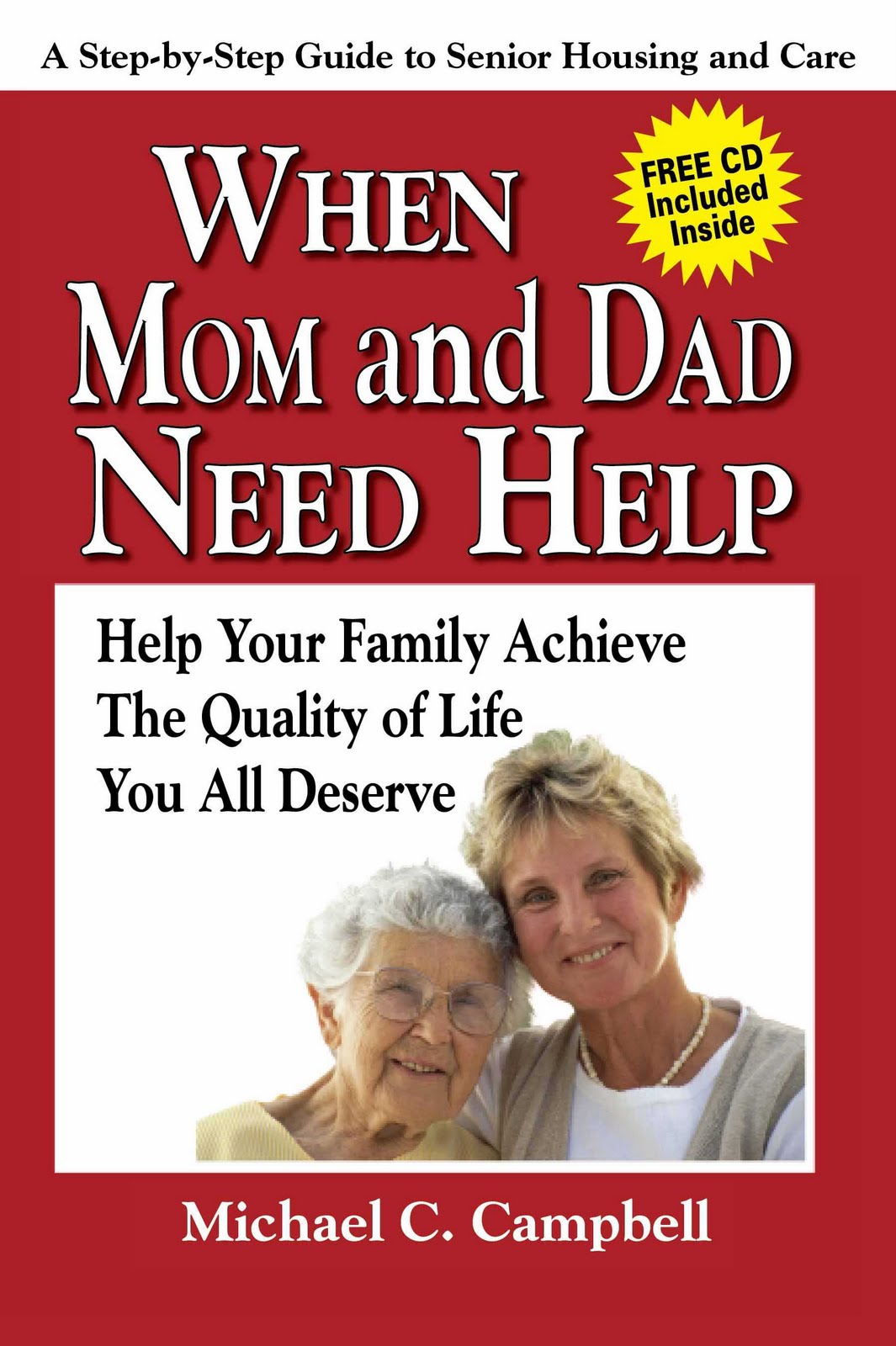
Book Review: WHEN MOM AND DAD NEED HELP

Book Review: WHEN MOM AND DAD NEED HELP:


I honestly wish I could have read this book before my father’s health began to seriously decline. Had that been the case, it’s likely my mother and I would not have felt so overwhelmed and as if scrambling all the time to find the best options for his care.

In WHEN MOM AND DAD NEED HELP, by author Mike Campbell, the adult children of aging parents are fortunate to have a most valuable resource at hand. Thorough and complete, this book clearly covers the wealth of options available to you when your parents need help. Mr. Campbell reveals the pros and cons of everything from having your parents move in with you, to adult day and home care services, to independent and assisted living, as well as dementia care, nursing facilities, and hospice care. He also details relative costs of each option you could possibly choose with your aging parents, besides where support opportunities may be found.

As any who have experienced this stage of life will attest, this is not an easy time for all involved. Routinely, it seems, things go until the 13th hour before a necessary adjustment in living or care arrangements transpire, and often only after a traumatic event precipitates the transition. Whether it is a fall, growing cognitive problems, a stroke, or whatever else that usually forces the living adjustment, Mr. Campbell recognizes that such desperate situations need not be the case. Accordingly, in the early chapters of the book, the author details many of the telltale signs and indicators that point to the necessity of an aging parent possibly needing some form of assistance or care. And, no doubt, if adult children of aging parents paid more attention to these warning signs, much of the stress and anxiety surrounding these difficult times might be alleviated. Wisely then, the author stresses the importance of proactively discussing long-term care needs with aging parents and planning for the inevitable before it becomes absolutely necessary. He also brings up multiple approaches for engaging in this difficult but necessary discourse, all in an effort to make the inevitable life changes as comfortable as possible for all involved. As adult children and aging parents eventually come to agree that some form of additional help is necessary with aging parents, the author outlines a five-step process to selecting the best senior housing and care option for one’s aging mom or dad. This includes assessing parents’ current and future care and assistance needs, identifying all senior housing and care options available in their area, conducting telephone surveys of senior housing/care options, conducting in-person interviews of the same, and making your final evaluation and decision.

An admirable counterpart and complement to WHEN MOM AND DAD NEED HELP can be found on author Mike Campbell’s website at http://www.iffenwen.com/. Here the adult child of aging parents can find free checklists to conduct telephone surveys, tours, and interviews of various senior housing and care options. These checklists are very powerful tools whether you are interested in home care, adult day services, assisted living, nursing care, or Alzheimer’s/dementia and hospice for your parents. As the website notes regarding these eighteen free checklists: “It’s like having your own personal long-term care expert assisting you through each step!” Mr. Campbell concludes his book with chapters about helping parents cope with their new environment and more regarding how essential planning ahead for aging parents can be. An informative section about long-term health care insurance can be found as well – with a subtitle, “Is it worth it?” Sooner or later, nearly everyone will find himself or herself in the situation of being either an aging parent, or an adult child of an aging parent. What Mr. Campbell has done with WHEN MOM AND DAD NEED HELP is to give us all a viable and exhaustive roadmap for successfully traversing these difficult and stressful times. My expectation is that this book will prove itself a valuable resource to more and more people in the years to come.

Thank you, Mr. Campbell, for the time and effort you expended in writing this book!

Posted by Mike Penney, author of "The Coming Tsunami" on 04/01/2012 at 8:25 AM at http://www.mikepenney.com/.

Note from Author Mike Campbell:
To help find the book, here are various links to purchase WHEN MOM AND DAD NEED HELP online in both print and Ebook format:

Monday, January 30, 2012

Author Mike Campbell to Appear on The Balancing Act on Lifetime TV

How to care for your aging parents is probably one of the most difficult and emotionally trying situations you'll face. And let’s face it. The responsibility typically falls on the woman’s shoulders. Would you like to learn how to make this process less stressful? Tune-in to The Balancing Act on Lifetime Television on Valentine's Day, February 14th at 7am ET/PT to find out MORE!!!! Senior care care expert Mike Campbell will give you tips on how to get yourself prepared and become the best care advocate for your parents.

Check out the Tune-in link to Mike's appearance on The Balancing Act here:
http://www.thebalancingact.com/video/?v=N96KESEVR03657

Mike Campbell is the author of the award winning book titled When Mom and Dad Need Help. The book is designed to help families cope with these difficult decisions by educating them about the process and providing them with a step-by-step plan. It provides the reader with an easy-to-navigate five-step process to help them find the long-term care option that best meets their aging parent’s needs by maximizing their independence, dignity and overall quality of life.

The book also contains a Free CD with a total of 18 different printable checklists to conduct telephone surveys, tours and interviews of all the various senior housing and care options. These checklists are valuable tools that help the reader gather all the vital information necessary to make their decision. You simply print out all the files for the type of option you’re interested in, whether it be independent living, home care, adult day services, assisted living, Alzheimer's/dementia care, nursing care, Continuing Care Retirement Communities, or hospice care. Everything is all laid out for you. Just use them as you would a grocery list. It lists the types of questions you need to ask during a telephone survey or interview, the things you need to look for during a tour…it's like having your own long-term care expert as your personal assistant. And best of all, the reasons why each of the answers to these questions are so important to your decision are explained in extraordinary detail within the book. It's an incredibly powerful tool!

The Balancing Act airs nationally on Lifetime Television Monday – Friday at 7a.m. ET/PT. For more information about the author and the book, go to www.iffenwen.com or contact Mike directly at mike@iffenwen.com.

Saturday, August 6, 2011

"When Mom and Dad Need Help" wins 2010 ForeWord Reviews' Book of the Year Award


Traverse City, Michigan - June 25, 2011 - ForeWord Reviews is pleased to announce the winners of its 2010 Book of the Year Awards. http://www.bookoftheyearawards.com/winners/2010/

At a ceremony during the American Library Association Conference in New Orleans, the 215 Book of the Year winners in 60 categories were honored. These books, representing the best independently published books from 2010, were selected by a panel of librarian and bookseller judges.

"When Mom and Dad Need Help" won the "Silver Award" in the Family and Relationships category. http://www.bookoftheyearawards.com/winners/2010/category/family-and-relationships/

"I would like to thank ForeWord Reviews for this award. I am very humbled and honored to accept this prestigious award. I really believe in this book. I put a lot of time and effort into it and I believe it shows. It helps educate people about the long-term care process so they can not only find quality senior housing and care options for their parents but also help them plan for their own long-term care needs as well! All the critical acclaim I have received is great but the most important thing I want to happen is for people to get out there and educate themselves about the process now before their parents and loved ones need help! " - Mike Campbell

For more information on the book and where to buy it, go to http://www.iffenwen.com/

Wednesday, May 18, 2011

"When Mom and Dad Need Help" wins an IPPY Award!


FOR IMMEDIATE RELEASE


Traverse City, Michigan – May 5, 2011 - Announcing the 15th annual Independent Publisher Book Awards, honoring the year’s best independently published titles, Iffenwen Publishing Company is pleased to announce that When Mom and Dad Need Help has won the Silver Medal in the Aging Category.

Click on the link below to see the official results of this year's awards, starting with the gold, silver and bronze medalists in 69 National categories, followed by the Regional categories and Outstanding Books of the Year. These 346 medal-winning books came from 45 U.S. states plus the District of Columbia, 7 Canadian provinces, and 7 countries overseas. The medalists were chosen from 3,907 total entries: 3,059 in the national categories and 848 in the regional categories. Judges found excellence in every category, and proclaim the quality, creativity, and originality of independent publishing to be better than ever. http://www.independentpublisher.com/article.php?page=1442.

“I am very humbled and honored to have won the Silver Medal in the Aging category. I look forward to accepting my IPPY at the Independent Publisher Book Awards Ceremony on Monday, May 23rd in New York City, kicking off this year's BookExpo America convention. Congratulations to all the winners! I look forward to seeing you all in the Big Apple.” – Mike Campbell

ACCLAIM FOR WHEN MOM AND DAD NEED HELP

“Anyone and everyone close to an older family member should read this book. Reading through this book and discussing it together provides a simple, loving, and gentle way to begin planning the very best solution to senior care. The book presents information in an easy-to-understand way that always feels caring, encouraging, and hopeful. And for a book mainly intended to pass along straight facts and advice, it is an enjoyable read as well.” — Diane Gardner, ForeWord Reviews

“This is a much needed book that is well-written for the consumer. The telephone surveys, as well as the tour and interview checklists are excellent guidelines and tools.”
Sister Roseann E. Kasayka Ph.D., MT-BC, DA

“For those caring for aging parents and loved ones, this book is a must read. With the multiple choices and complexities associated with senior care health care options, it is imperative that caregivers become educated consumers. This book is a comprehensive resource that will give you the education and information you need to become the best advocate for your loved one.”
Lisa Fluhart, Licensed Nursing Home Administrator

“This is an excellent “how to” reference book on options for caring for a parent. I especially appreciated the suggested language on how to have those difficult conversations.”
Elizabeth Ford Pitorak, MSN, CNS, FPCN

“This book provides excellent step-by-step instructions that can be followed down multiple pathways, which is exactly what is needed.”
Carol Faytol, RN

WHERE CAN YOU BUY THE BOOK?

When Mom and Dad Need Help is available at a number of online websites including Amazon.com, BarnesandNoble.com and the publishers website at http://www.iffenwen.com/buybook.html.
It can also be ordered directly from the publisher's distributor, Pathway Book Service: 4 White Brook Road, P.O. Box 89, Gilsum, NH 03448, Phone: 800-345-6665; or from your favorite Wholesaler or Distributor.

The Independent Publisher Book Awards were conceived in 1996 as a broad-based, unaffiliated awards program open to all members of the independent publishing industry. The awards are intended to bring increased recognition to the thousands of exemplary independent, university, and self-published titles produced each year, and reward those who exhibit the courage, innovation, and creativity to bring about change in the world of publishing.

Mike Campbell has been an advisor to the senior housing and care industry for over 18 years. Campbell now wants to share the knowledge he’s gained over the years and become a dedicated consumer advocate for those families looking to find quality long-term care options for their loved ones by educating them and giving them a plan. For more on the author and how to order the book, go to http://www.iffenwen.com/. You can order the book toll-free at 1.800.345.6665. The book is also available on Amazon.com and BarnesandNoble.com.

Thursday, April 7, 2011

"When Mom and Dad Need Help" is a Finalist in the ForeWord Reviews 2010 Book of the Year Awards


FOR IMMEDIATE RELEASE


Traverse City, Michigan – March 14, 2011 - When Mom and Dad Need Help has been selected as a Finalist for the ForeWord Reviews' 2010 Book of the Year Awards in the Family and Relationships category. This is posted on the ForeWord Reviews' website at http://www.bookoftheyearawards.com/finalists/2010/category/family-and-relationships.

As an advisor and consultant to the senior housing and care industry for more than 18 years, Mike Campbell has witnessed both the best and worst of senior housing and care. With the release of his new book, When Mom and Dad Need Help, he shares and advises on what he’s learned in nearly two decades of research and experience. A consumer advocate for families looking for long-term care options for loved ones, Campbell gives the adult child the education and information necessary to become the best advocate for their loved ones. Campbell guides readers to uncover the senior housing and care option that best meets their parents’ needs; one that maximizes their independence and enhances the quality of everyone’s lives in the process. The book stands out from any other on the subject because it can be followed down multiple pathways depending on each person’s unique physical, mental and financial situation.

“We, as a nation, need to transition ourselves from a ‘Caregiver 911’ approach to a ‘Caregiver 101’ approach. It seems ‘the formula’ these days is to wait until we, or our parents, suffer some traumatic event, or ‘wake-up call’, that leaves us very little time to make some very important and gut-wrenching decisions. We all need to talk and educate ourselves about the process NOW before Mom and Dad need help! This is why I wrote this book. I want to help everyone prepare for what lies ahead” – Mike Campbell

WHERE CAN YOU ORDER THE BOOK?

When Mom and Dad Need Help is available at a number of online websites including Amazon.com, Barnes and Noble.com and the publishers website at http://www.iffenwen.com/buybook.html.

It can also be ordered directly from the publisher's distributor, Pathway Book Service: 4 White Brook Road, P.O. Box 89, Gilsum, NH 03448, Phone: 800-345-6665; or from your favorite Wholesaler or Distributor.

ForeWord Reviews' Book of the Year Awards program was established to help publishers shine an additional spotlight on their best titles and bring increased attention to librarians and booksellers of the literary and graphic achievements of independent publishers and their authors. Award winners are chosen from real librarians and booksellers, who are on the front lines everyday working with patrons and customers. ForeWord is the only review trade journal devoted exclusively to books from independent houses.


Mike Campbell has been an advisor to the senior housing and care industry for over 18 years. Campbell now wants to share the knowledge he’s gained over the years and become a dedicated consumer advocate for those families looking to find quality long-term care options for their loved ones by educating them and giving them a plan. For more on the author and how to order the book, go to http://www.iffenwen.com/. You can order the book toll-free at 1.800.345.6665. The book is also available on Amazon.com.

Monday, July 26, 2010

28 Home Remodeling Tips to Make Your Home More Senior Friendly!

Even as a young girl who had just awakened from a crazy dream, Dorothy of The Wizard of Oz knew - “There’s no place like home.” Our homes are where we find warmth, security and the comfort of familiar surroundings. While today’s seniors are fortunate to have so many housing and care options available to them, for some, nothing will ever equal living in the home they've been living in for many years. While senior communities and assisted living facilities are perfect choices for some seniors, other prefer to remain in their own homes when facing the challenges of aging and illness. The problem with the latter being a viable option is that, in many cases, people are not able to stay in their homes because they are physically unsupportive environments that lack the necessary design features to ensure safety and accessibility.

It is for this reason, that many baby boomers and beyond are beginning to plan and incorporate various home modifications into their homes. Many are making modifications to their homes so that as they grow older, it will allow them to function independently and safely in their homes for a longer period of time. How well and long you live in your current home will really depend on how well you adapt and remodel it now.

"The art of life is a constant readjustment to our surroundings." ~ K. Okakaura

When you start to consider a home modification plan, there are three main areas of improvement you should consider to make your home a safer environment: (i) Safety, (ii) Lighting, and (iii) Accessibility.

Safety Modifications

By far, the biggest concern for seniors is falling down. Nine out of ten broken hips are the result of falls; therefore, implementing safety and prevention measures are a must. After all, a broken hip usually buys you a first-class ticket to the nursing home which results in the immediate loss of your independence. Modifications made to prevent falls are easy and probably the most important ones you can make. Some of these are listed below.
  1. Replace all bathroom tubs with shower stalls complete with molded or pull-down seats because nothing is more dangerous than trying to get in and out of a slippery tub. The shower stall floor should incorporate non-skid strips or slip-resistant tiles for fall prevention;
  2. Install grab bars in the shower stalls; you may even consider a floor-to-ceiling safety pole in the shower stall for additional safety and ease of use;
  3. Install hand-held showerhead;
  4. Install grab bars around all toilet areas;
  5. Install raised toilet seats making it easier for an aging adult to get on and off the toilet;
  6. Install handrails on both sides of the stairs for better support;
  7. Consider installing floor-to-ceiling support poles near beds, favorite chairs and toilets to help ease transfer on and off;
  8. Replace carpeting and tile flooring with non-slip/skid type flooring. They should be tight and firm to walk on, helping to prevent falls and providing ing an easy walking environment;
  9. Install non-skid rubber strips on the edge of stairs to help prevent falls, Carpet-free stairs are typically safer;
  10. If possible, eliminate all stairs from your home’s design;
  11. Install anti-scald devices on faucets and showerheads;
  12. Review accessibility of electrical outlets to reduce the need for dangerous extension cords.
Lighting Modifications

As we get older, we need two to three times more light than we needed when we were younger. Proper lighting and visibility is also an important safety measure as well to help prevent falls. Here are some ideas to help improve lighting and visibility in your home:

  1. Review your home’s lighting to make sure you have sufficient, even lighting throughout and add additional lighting, if needed;
  2. Review and assess the placement of all of your light switches. Make sure light switches are located close to room entrances and at the top and bottom of stairways;
  3. Install lighted switch plates so you’ll always be able to easily locate the switch at night;
  4. Install lights inside closets and cabinets;
  5. Install under-cabinet lighting in the kitchen;
  6. Install motion-sensor exterior lighting;
  7. Make sure you use high watt light bulbs in stairways and other hazardous areas;
  8. Consider installing design features that increase the amount of natural light in your home. Research has proven that daily exposure to natural light can support and nurture a person’s health and well-being. This can be accomplished by adding a skylight, more windows, or maybe converting one of your first floor rooms into a sun room?

Accessibility Modifications

These are design considerations that will help improve accessibility and make your home easier to live in as you age in place.

  1. Locate countertops, cabinets and shelving to lower heights for easier access. As we grow older, these lower levels willth make things easier to reach as our mobility, balance, reach and range of motion declines;
  2. Convert kitchen cabinets into drawers to hold pots and pans for easier access;
  3. Replace door knobs with lever handles. As we age, it is much easier to operate a lever than a door knob;
  4. Install lever-handle faucets in kitchen and bathrooms;
  5. Locate windows at lower levels so you can see the ground from a couch, chair or bed. Why not enjoy the view of the outdoors while seated?
  6. Consider increasing door opening sizes from the basic 29 to 30 inches to as much as 36 to 42 inches to allow a wheelchair to freely navigate the home. The installation of pocket doors to replace regular doors may give you the width you desire;
  7. Install a permanent or portable wheelchair ramp;
  8. Install a stair chair lift.

While the following are just a few ideas and modifications that can help you remain independent and in your home for a longer period of time, there are so many others that will be specific to your home and needs. Once you have begun your plan you should contact a home modification specialist who can give you many more aesthetic and functional ideas to accommodate your person needs.

Mike Campbell is the author of a new book called "When Mom and Dad Need Help" (May 2010) which helps the adult child work together with the aging parent to begin planning the very best solution to senior care. Mike has been an advisor to the senior housing and care industry for over 18 years. Campbell now wants to share the knowledge he’s gained over the years and become a dedicated consumer advocate for those families looking to find quality long-term care options for their loved ones by educating them and giving them a plan. For more on the author and how to order the book, go to http://www.iffenwen.com/. You can order the book toll-free at 1.800.345.6665. The book is also available on Amazon.com.

Sunday, June 20, 2010

Have "The Talk" With Your Parents Today!

It’s hard to imagine our parents as less than self-sufficient. Sitting down and talking with them about their future long-term care needs is an even more agonizing thought. Let’s face it; most of us would rather bury our heads in the sand than discuss this subject with our parents. When a difficult situation like this arises, I’m reminded of the TV commercial that depicts a man in overalls expressing his displeasure at dealing with a car salesman by bellowing, in a Southern drawl, “I’d rather be pecked to death by a duck!” When it came to approaching my mom about her future senior housing and care needs, this was my sentiment exactly!

It’s time for a reality check, folks. Based on discussions with hundreds of adult children who’ve gone through this ordeal, talking openly with your parents about their needs for long-term care, and planning for the inevitable before it becomes absolutely necessary, is much better than dealing with it on your own later. Helping your parents prepare for their future housing
and care needs will go a long way toward eliminating any future guilt. The secret is in getting started. The small amount of pain you experience talking about it now will go a long way toward eliminating the pain and guilt you’ll experience later if you don’t.

You’ve undoubtedly thought: I never want to be a burden to my children when the time comes that I need care. Well, your parents feel exactly the same way. Research has proven that this is so. The time to talk with your parents about their future housing and care needs is now, while they’re in reasonably good physical and mental health. All of your parents’ children should be involved in the discussion. Decisions reached as a group are vitally important because the decision will not only affect your parents, but also each member of the family. Group decisions are more likely to be successful than unilateral decisions. Even if some of your siblings can’t attend a meeting, keep them informed of any decisions made, preferably in writing. It would be unfortunate if one of your siblings were unaware of your parents’ wishes for housing and care, later resulting in a disagreement over what your parents’ wishes really were. Obviously, the final decision is going to reside with your parents as long as they’re mentally capable. If your parents are still capable of being involved in the decision-making, their participation makes the entire process much easier.

A wise man once said, “Every battle is won before it’s fought.” This could not be more applicable than with senior housing and care planning. Let me give you an example. Last year, my friend’s mother died suddenly. Her father had developed Alzheimer’s disease about four years ago and was requiring assistance with several activities of daily living. Her mother was caring for, and tending to her husband’s needs from their home of fifty years. When her mother suddenly died, she and her brother could not agree on what type of housing and care would be best for their dad. It was a very unpleasant experience for both her and her brother. The “guilt factor” was something that played on both of their minds. She told me that she wished they could have sat down earlier with their dad before he developed Alzheimer’s disease and discussed what his wishes would have been in this situation. It would’ve made the decision to move him into an Alzheimer’s/dementia care community a much easier one.

How do I Broach the Subject?

I’ll give you four great tips to having “The Talk” with your parents:

1. Be honest and direct with your parents - Ask your parents’ permission to discuss the topic with them. A couple of good examples to open with: “I’d like to talk with you about how you’d like to be cared for if you got really sick and were unable to care for yourself anymore. Is that okay?” Or, “If you ever got really sick, I’d be afraid of not knowing what kind of care you’d prefer. Could we talk about this now? I’d feel better if we did.”

2. Be a good listener – As my grandmother used to say, “God gave us two ears and one mouth for a reason.” Hear what your parents are saying without interrupting, giving your opinion, or telling them what to do. Rather than offer advice, let them work things out for themselves as they talk. As a good listener, you can help your parents explore their situation by asking them open-ended, non-threatening questions like “What specifically concerns you about moving into a retirement community Mom?” or “How do you feel about this Dad?”

3. Take advantage of opportunities that may arise to help break the ice - For example, a perfect opportunity to discuss your parents’ future housing and care needs would be when one of their friends or family members suffers a traumatic event that requires them to consider senior housing, care or assistance. Bring up some “What if?” scenarios: What if Mom couldn’t get up and down the stairs anymore like Mrs. Smith? What if Dad couldn’t drive anymore like Mr. Jones? What if both of you suddenly needed help with certain activities of daily living? What would your wishes be if you could no longer live at home without assistance? Are you aware of the different housing and care options? Have you thought about how you’ll pay for such housing and care? Tell your parents how much you love them and how you’re willing to work with them together to find answers to these tough questions.

4. Never make promises – This is probably the most important tip of all! Never make promises to your parents such as “We’ll never put you in a nursing home” or “You can always come and live with us, we’ll take care of you.” Circumstances change over time, and what may seem like the best solution now may not be the best solution years from now. Unfulfilled promises can only result in extreme guilt, anxiety, and pain.

Remember---The open communication you have with your parents today will be the “key” to your caregiving experience tomorrow. This initial communication is the all-important first step that will allow you the freedom to have further conversations with parents about the subject; and, these initial conversations will hopefully result in both of you researching and developing your own individual plans for handling those future long-term care needs.

How am I going to pay for my future long-term care needs?

One of the concerns we all have is how in the world we’re going to pay for our future long-term care needs. Qualifying financially is probably going to be the single biggest obstacle for most families. Most people still think their regular health insurance or Medicare is going to cover the cost of their long-term care. This is just not the case. Neither of these covers long-term care. Today, to get the care they need, most seniors have no option but to spend down their hard-earned retirement savings to near zero and then turn to the state and federally funded Medicaid program for assistance. The problem with this is, once you start depending on the government to pay for your housing and care needs, you lose the freedom to decide where you’ll be housed and cared for.

Not only does this affect your parent’s financial condition, it may affect your own. It is estimated that over 40% of adult children caring for their aging parents are providing them with some degree of financial support. Adult child caregivers are spending their retirement savings and vacation funds to help Mom and Dad get the quality care they need.

This is precisely why I believe, looking forward, private long-term care insurance MUST play a vital role in funding the care for our growing aging population. If you have the financial means, I would highly recommend you invest in a private, long-term care insurance policy. Long-term care insurance gives you the financial freedom to choose from a lot more housing and care options that you would otherwise not be able to afford without it. It’s a valuable investment that brings long-term prosperity by preserving your assets and protecting you and your spouse from impoverishment should one or both of you require long-term care. If you can afford it, do your part, and leave the dollars allocated to the state and federally funded Medicaid program to the lower-income Americans who really need it.

We Need to Transition from “Caregiver 911” to “Caregiver 101”

We, as a nation, need to transition ourselves from a “Caregiver 911” scenario to a “Caregiver 101” scenario. It seems ‘the formula’ these days is to wait until we, or our parents, suffer some traumatic event, or “wake-up call”, that leaves us very little time to make some very important and gut-wrenching decisions. As our parents lie in a hospital bed, recovering from whatever led them to needing long-term care, we typically end up running around, as if our hair was on fire, trying to desperately find a quality care option that will meet Mom or Dad’s needs--- yet we really don’t know where to begin or what to look for! Sound like fun? No? Then let’s do something about it! We all need to educate ourselves about the process now before Mom and Dad need help.

Help Me Spread the Word!

My life’s mission is to inspire everyone to open up and have these tough conversations with their parents today. In fact, I suggest these conversations be conducted across all generations (i.e., you should have these talks with your children as well). Let’s all do our civic duty and spread the word to anyone who will listen. Tell people you care about! Tell people you don’t care about! Everyone needs to know about what lies ahead and what steps can be taken to make this process as painless as possible. Open communication is extremely vital to planning for the future.

We all can become the best care advocate for our loved ones by:

1. Talking with our loved ones today about their future care needs while they are still healthy;

2. Educating ourselves about all the long-term care options available in the market; and

3. Making sure we have a sound financial plan to pay for such care.


===================================================

Mike Campbell is the author of a new book called "When Mom and Dad Need Help" (May 2010) which helps the adult child work together with the aging parent to begin planning the very best solution to senior care. Mike has been an advisor to the senior housing and care industry for over 18 years. Campbell now wants to share the knowledge he’s gained over the years and become a dedicated consumer advocate for those families looking to find quality long-term care options for their loved ones by educating them and giving them a plan. For more on the author and how to order the book, go to http://www.iffenwen.com/.